What is a visual illusion? Discuss different types of optical illusions.
Introduction

You’ve probably stared at an image online that looked like it was spinning—even though it wasn’t. Or maybe you’ve seen those infamous illusions where one line looks longer than the other, even though they’re the same. Welcome to the world of visual illusions— where your brain becomes the trickster and the tricked, all at once.
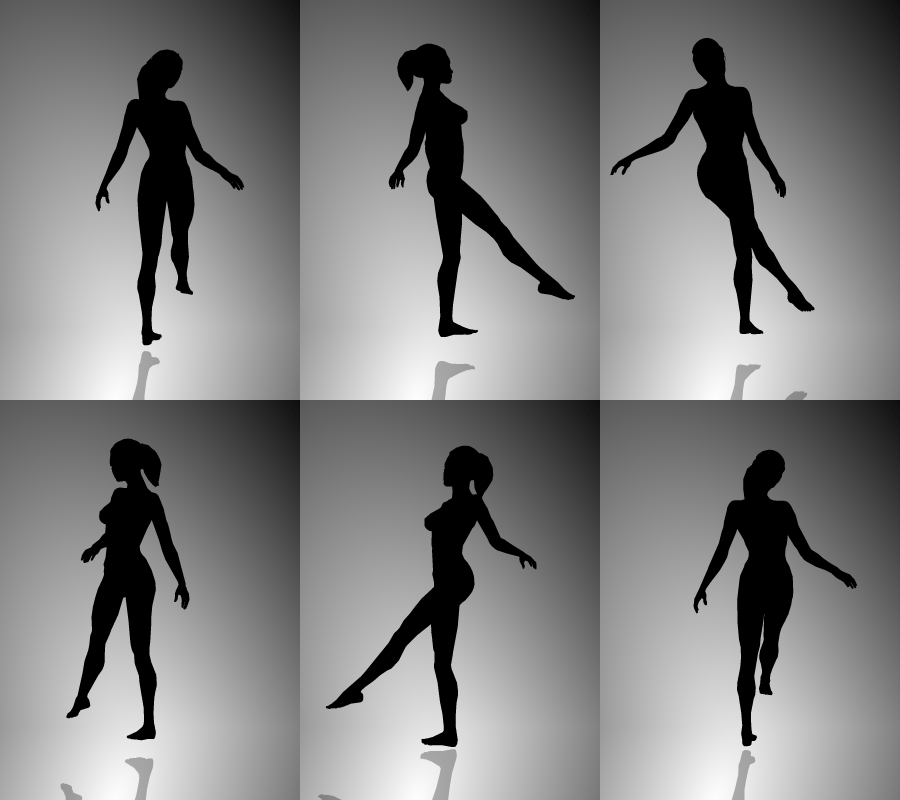
Spinning Dancer: Image by Nobuyuki Kayahara, via Wikimedia Commons – Licensed under CC BY-SA 3.0
So, what is a visual illusion? Simply put, it’s when what you see doesn’t match what is actually there. But the deeper story lies within your brain—how it interprets light, shapes, motion, and context to make sense of the world.
In this post, we’ll dive into what visual illusions are, why they happen, and explore types of optical illusions—with real-life examples, expert insights, and a few surprises.
What is a Visual Illusion?
A visual illusion, also known as an optical illusion, is a misperception or misinterpretation of a real visual stimulus. In simpler terms, it’s when your brain receives accurate sensory information from the eyes—but ends up misjudging what it means.
Our visual system is constantly trying to make sense of limited or ambiguous information. It uses shortcuts—called perceptual heuristics—to fill in the gaps. Most of the time, these shortcuts help us survive. But sometimes, they fool us. And that’s when we experience a visual illusion.
Visual illusions aren’t just curious puzzles—they’re powerful tools used in psychology to study how perception works. By examining where and how our brain goes “wrong,” we gain insight into how it usually gets things right.
Gregory (1970) said that these illusions happen because our brain is trying to use rules it usually uses in the real world, but they don’t work properly in these fake situations.
Example:
- In the Müller-Lyer illusion, two lines look like they’re different lengths—but they’re actually the same. Our brain uses depth rules (like in 3D spaces) even when it’s just a flat image.
- The Moon illusion: The moon looks bigger on the horizon than up in the sky—but it’s the same size. That’s because we think things near the horizon are farther away, so our brain “stretches” the size.

Moon Illusion: Image via Wikimedia Commons – Public Domain
Gamma and negative afterimage illusions are visual phenomena that occur when the eye’s photoreceptors adapt to prolonged exposure to a stimulus, resulting in the perception of complementary colors or luminance when the stimulus is removed. Negative afterimages, specifically, are the most well-known, where the perceived colors are the opposite of the original stimulus.
Negative Afterimages:
- How they work:When you stare at a bright image for an extended period, the cells in your retina that respond to that specific color or light become fatigued or desensitized.
- Complementary colors: When you shift your gaze, the surrounding, less-stimulated cells send a stronger signal, creating the perception of an image with inverted colors, known as a negative afterimage.

Types of Visual Illusions
Optical illusions come in many forms, but most can be broadly categorized into two types: illusions of motion and illusions of form. Let’s explore each in detail, with real-life examples to bring them to life.
1. Illusions of Motion: When the Still Starts to Move
These illusions make us see motion where there is none. Our brain is highly sensitive to movement—it helps us detect threats, find food, and navigate the world. But sometimes, it misfires.
Phi Phenomenon
Ever watched a blinking marquee sign or a flipbook and seen movement in still frames? That’s the phi phenomenon. First described by Gestalt psychologist Max Wertheimer, it’s how we perceive continuous motion when lights flash in rapid sequence.
Example: The illusion is what makes animated movies work—still images that our brain blends into smooth movement.
Induced Motion
If you’re sitting in a stationary train and the train next to you starts to move, you might feel like you’re moving backward. That’s induced motion—when the background moves, our brain mistakenly attributes motion to the still object.
Autokinetic Effect
In a pitch-dark room, a single point of light will seem to drift—even though it’s not moving. This is caused by tiny, involuntary eye movements that the brain interprets as movement of the object.
Example: Early psychology experiments used this illusion to study social norms (Sherif, 1935), asking participants how far the light moved—and watching how group influence changed their answers.
Stroboscopic Motion
This illusion happens when a series of still images are shown rapidly, creating the perception of motion. It’s closely related to the phi phenomenon, but involves subtle changes between each frame.
2. Illusions of Form: When Shapes and Sizes Deceive You
These illusions alter how we perceive shape, size, angle, or depth. They often occur because the brain makes assumptions about 3D space based on 2D cues.
Müller-Lyer Illusion
Two lines of the same length appear different because of the arrowheads at the ends—one line has inward arrows, the other outward. Your brain interprets these as depth cues, making one line seem longer.
Ponzo Illusion
Place two identical lines between converging lines (like train tracks) and the top one looks longer. That’s because the brain interprets the background as a sign of depth—and assumes the top line is farther away, so it must be bigger.
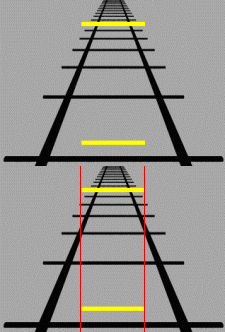
Ponzo Illusion: Image via Wikimedia Commons – Public Domain
Zollner and Hering Illusions
The Zollner and Hering illusions are examples of visual illusions where straight lines appear distorted due to the influence of intersecting lines or background patterns. The Zollner illusion involves parallel lines that appear to diverge or converge because of short, oblique lines intersecting them. The Hering illusion, on the other hand, features parallel lines that appear to bend outward (or inward) when they are crossed by radiating lines.

Zollner Illusion: Image via Wikimedia Commons – Public Domain
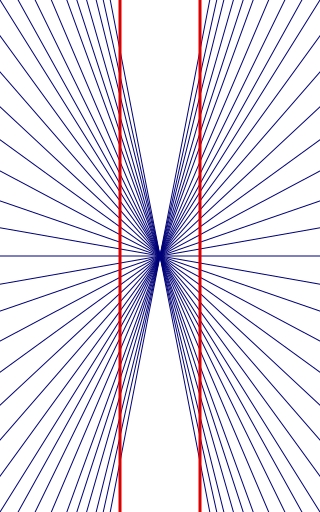
Hering Illusion: Image via Wikimedia Commons – Public Domain
Horizontal-Vertical Illusion
A vertical line appears longer than a horizontal one, even when both are the same length. This illusion likely stems from how we judge vertical space as more distant or “taller” than it is.
Reversible Figures (Ambiguous Images)
Think of the famous duck-rabbit or the Rubin vase—a single image that can be seen in multiple ways. Your brain can only hold one interpretation at a time, so it flips back and forth between alternatives.

Duck-Rabbit Illusion: Image via Wikimedia Commons – Public Domain
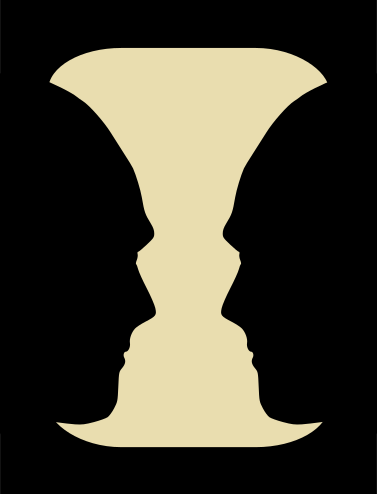
Rubin Vase: Image via Wikimedia Commons – Public Domain
Context and Closure Illusions
Your brain tends to fill in missing information—this is the Gestalt principle of closure. You might “see” a triangle that isn’t drawn, just because the edges are implied. Similarly, a grey square looks darker or lighter depending on its background—a context illusion.

Kanizsa Triangle: Image via Wikimedia Commons – Public Domain
Ames Room
This is a specially designed room that looks rectangular from a fixed viewpoint—but is actually trapezoidal. People standing inside appear to grow or shrink as they move, even though their size hasn’t changed. The illusion works by manipulating depth cues and forcing a single point of perspective.

Ames Room: Image via Wikimedia Commons – Public Domain
Impossible Figures
These are drawings that create the illusion of three-dimensional objects that can’t physically exist—like the Penrose triangle or Escher’s impossible staircase. Your brain tries to reconcile the conflicting information, and ends up believing the impossible.

Impossible Cube: Image via Wikimedia Commons – Public Domain
Poggendorff illusion
The Poggendorff illusion is a visual perception phenomenon where a straight line, partially obscured by a rectangular or other shape, appears offset from its true alignment when viewed through the obstructing shape. Specifically, the observer tends to perceive the line segments as misaligned, with one segment appearing shifted vertically or horizontally relative to the other.

Poggendorff Illusion: Image via Wikimedia Commons – Public Domain
The Brain’s Visual Processing System
Our visual system operates through two main pathways:
Bottom-up processing
Bottom-up processing starts with external stimuli hitting our retinas, sending signals through the optic nerve, thalamus, and into the visual cortex.
Let’s now try to understand some illusions using bottom-up perception—which means starting from the raw information your senses receive (like light and shapes hitting your eyes) before your brain adds meaning or uses memory.
🧠 Gibson’s View – The Necker Cube
- Gibson believed that we don’t need extra knowledge or memory to see things—we just use the info right in front of us.
- But with the Necker Cube, there’s not enough info (like shadows or textures) to tell us how to see it. That’s why our brain keeps switching between two ways of seeing the cube.
- So, the illusion happens because the raw data from our eyes isn’t clear enough, and we don’t get helpful clues like we would in real life.
 •
• - Necker Cube: Image via Wikimedia Commons – Public Domain
🔳 Marr’s Theory – Kanizsa’s Illusory Square
- Marr said we build up our perception in stages—from simple edges to full 3D shapes.
- In the Kanizsa Square, our brain notices the corners of missing circles and connects them into a square—even though no square is actually there.
- This shows bottom-up processing: our brain builds up the image step-by-step from what our eyes are seeing (light, edges, gaps).
- Image: Kanizsa Triangle via Wikimedia Commons (Public Domain)
Kanizsa’s Illusory Square: Image via Wikimedia Commons
↔️ The Müller-Lyer Illusion
- Two lines look different in length, even though they’re the same. Why?
- One idea: we group the line with its arrowheads into one full shape.
- The inward-pointing arrows make the whole shape look smaller.
- The outward-pointing arrows make it look bigger.
- So, we don’t just see the line—we see the whole object and judge its size based on that.
- This might come from bottom-up grouping rules (how we naturally organize shapes).
- But when curved arrows are used instead, the illusion isn’t as strong. That suggests top-down thinking (based on past knowledge) may also play a role.

- Müller-Lyer Illusion: Image via Wikimedia Commons – Public Domain
Top-down processing
Top-down processing involves feedback from higher brain regions, where our expectations and prior knowledge influence what we “see” – even when it’s not actually there.
🧪 Gregory’s Theory – Perception as a Guessing Game
- Gregory said we often don’t get complete information from our eyes.
- So, the brain has to guess what we’re seeing by forming “hypotheses”—like a scientist testing ideas.
- It picks the most likely explanation based on what you’ve seen before (your stored knowledge).
👀 Examples: How Knowledge Affects What You See
1. Blobs or Boat?
- Look at a blurry picture—you might only see random shapes.
- But if someone tells you “It’s an ocean liner,” suddenly you see it.
- That’s top-down processing—your knowledge fills in the gaps.
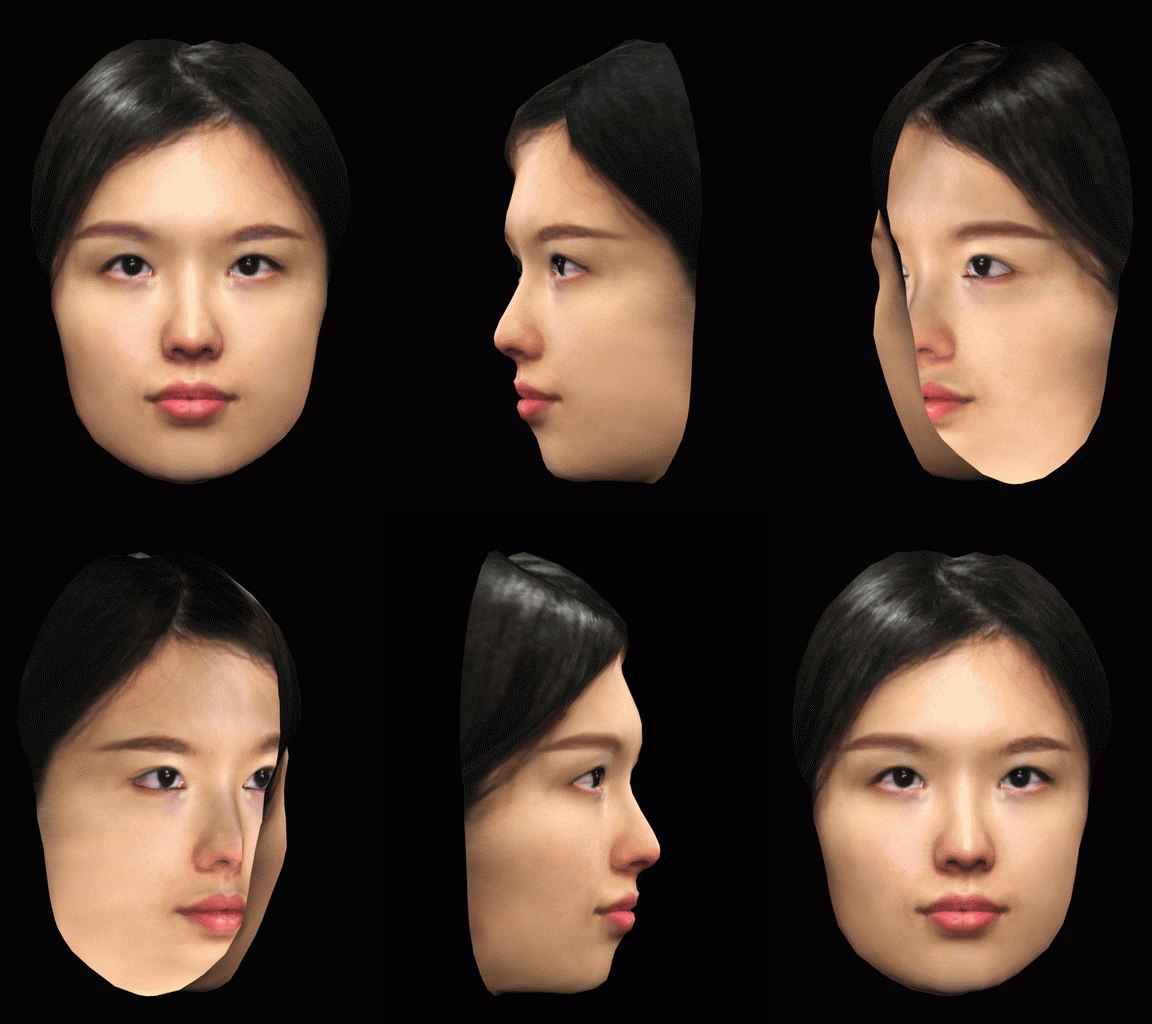
2. The Hollow Face Illusion
- When you look at the back of a face mask (which is hollow), your brain still sees it as a regular face.
- That’s because your brain has learned that faces are supposed to stick out—not go in.
- Even when you know it’s hollow, you still can’t help seeing it the other way. That’s a top-dow “mistake.”
-
3. The Impossible Triangle
- The Penrose triangle looks like a normal 3D triangle at first.
- But it’s impossible to build in real life!
- Your brain tries to make sense of each part, even though the whole shape is impossible.
- Again, your brain picks the most likely explanation, even if it’s wrong.
 Impossible Triangle: Image via Wikimedia Commons
The Three Main Categories of Visual Illusions
Understanding visual illusions becomes clearer when we organize them into three primary types, each revealing different aspects of how our visual system works.
Literal Illusions
Literal illusions occur when two images seamlessly blend to create the appearance of a single image, while your brain struggles to interpret whether it’s seeing one thing or two. The classic example is Rubin’s Vase, where you might see either a vase or two faces in profile, but rarely both simultaneously.
These illusions demonstrate how our brain constantly makes decisions about figure and ground – what’s the main object versus what’s background. Your visual system can’t hold both interpretations at once, so it flips between them.
Physiological Illusions
Physiological illusions happen when our eyes become overwhelmed by excessive stimulation – too much light, movement, or color. These illusions expose the physical limitations of our visual hardware.
Motion aftereffects are a perfect example. Stare at a waterfall for several minutes, then look at stationary rocks nearby – they’ll appear to move upward. This occurs because neurons responsible for detecting downward motion become fatigued, while those detecting upward motion remain fresh, creating an imbalance.
The famous “moving dots” illusion, where static patterns appear to wobble and shift, happens because tiny eye movements and blinking interact with high-contrast patterns, triggering our motion detection systems even when nothing is actually moving.
Cognitive Illusions
Cognitive illusions are the most complex category, involving our subconscious mind and how well our brain relates to images. These illusions reveal the sophisticated ways our visual system uses context, expectations, and learned patterns to interpret the world.
The Müller-Lyer illusion perfectly demonstrates this. Two lines of identical length appear different because of the arrow-like shapes at their ends. Our brain interprets these contextual cues as depth information, making one line seem closer and therefore smaller.
Why Do Optical Illusions Occur?
Visual illusions arise from a variety of cognitive and neural processes:
- Predictive Processing: Your brain uses prior knowledge to “guess” what’s coming next.
- Contextual Influence: What surrounds an object changes how you perceive it.
- Sensory Limitations: Your retina and visual cortex have constraints that the brain compensates for.
- Attention & Focus: What you expect to see can dramatically shape what you actually perceive.
In short: Optical illusions aren’t bugs in your system—they’re features. They show us how our mind constructs meaning, not just how our eyes see light.
Dr. Jolyon Troscianko’s research revealed a crucial insight: “Our eyes send messages to the brain by making neurones fire faster or slower. However, there’s a limit to how quickly they can fire, and previous research hasn’t considered how the limit might affect the ways we see colour”.
This “limited bandwidth” creates a bottleneck in visual processing. When overwhelmed by high contrasts or complex patterns, our neural pathways essentially get jammed, leading to the distorted perceptions we experience as illusions.
Why Visual Illusions Matter Beyond Entertainment
Medical Applications
Visual illusions serve as powerful diagnostic tools for vision problems and neurological conditions. They can help detect issues in specific parts of the visual processing pathway and are used in monitoring and rehabilitation for conditions like phantom limb syndrome and schizophrenia.
Insights into Consciousness
Illusions provide unique windows into consciousness itself. They reveal how subjective our perception really is and show that reality, as we experience it, is largely constructed by our brains rather than passively received.
Technology and Design Applications
Understanding visual illusions helps designers create more effective user interfaces, architects design spaces that feel larger or smaller, and engineers develop better display technologies. The research on high-contrast illusions even explains why high-definition televisions with extreme brightness ranges work so well.
The Future of Visual Illusion Research
Modern neuroscience tools like optogenetics are allowing researchers to manipulate specific neural pathways in real-time, providing unprecedented insights into visual processing. This research is revealing that visual illusions aren’t bugs in our system – they’re features that demonstrate the remarkable efficiency of our visual processing.
The latest findings suggest that our neurons are “precisely evolved to use every bit of capacity,” with different types of neurons handling different aspects of contrast and detail to maximize our visual capabilities within biological constraints.
Key Insights: What Visual Illusions Reveal About the Brain
Here’s what visual illusions really show us about how we experience reality:
| Insight | What It Means |
|---|---|
| Perception is constructed, not received | Your brain creates a best guess of reality |
| Context is everything | What surrounds a visual cue can completely change how you see it |
| The brain values speed over accuracy | Shortcuts help you survive—even if they occasionally mislead you |
| Attention is selective | What you focus on determines what you perceive |
| Vision is active, not passive | You’re not a camera—you’re a prediction machine |
Real-Life Applications of Visual Illusions
These aren’t just fun mind games—optical illusions have practical importance:
- Neuroscience & Psychology: Used to study how the brain processes perception and attention.
- Art & Design: Artists like M.C. Escher and Bridget Riley use illusions to create movement, emotion, and complexity in static images.
- Virtual Reality (VR): Understanding illusions helps developers make immersive and believable environments.
- Aviation & Safety: Illusions (like false horizons) can cause dangerous misjudgments for pilots, highlighting the need for instrumentation.
“Illusions aren’t flaws in perception—they’re windows into how perception works.” – Dr. Susana Martinez-Conde, neuroscientist
Conclusion
Visual illusions remind us that perception is not a passive recording of reality but an active, creative process. They showcase both the remarkable capabilities and inherent limitations of our visual system. Rather than being failures of perception, illusions demonstrate the elegant shortcuts and assumptions our brains use to navigate a complex visual world in real-time.
The next time you encounter a visual illusion, take a moment to appreciate the sophisticated neural machinery working behind the scenes. These perceptual puzzles aren’t just fascinating curiosities – they’re revealing fundamental truths about consciousness, reality, and the beautiful complexity of human experience.

🔍 Want to Explore More?
- Curious how attention and memory affect what you see? Check out our post here.
- For a deeper dive into illusion and emotion, watch our YouTube breakdown on visual perception at [@MindDecoded0]
- Love mind-bending content like this? Subscribe to our newsletter at www.nafeesafiaz.com for weekly psychology gems.
Have you ever been fooled by an optical illusion? Share your favorite one in the comments, or tag us on Instagram